
Science
Subject Leads – Carlota Reviriego & Hayley Earley
Science
Children are naturally curious, and our Science curriculum is designed to build upon this. We believe Science is a fundamental core subject that allows children to understand the world through a logical, inquisitive lens. By providing high-quality science lessons we can teach our pupils to become critical thinkers and problem solvers.
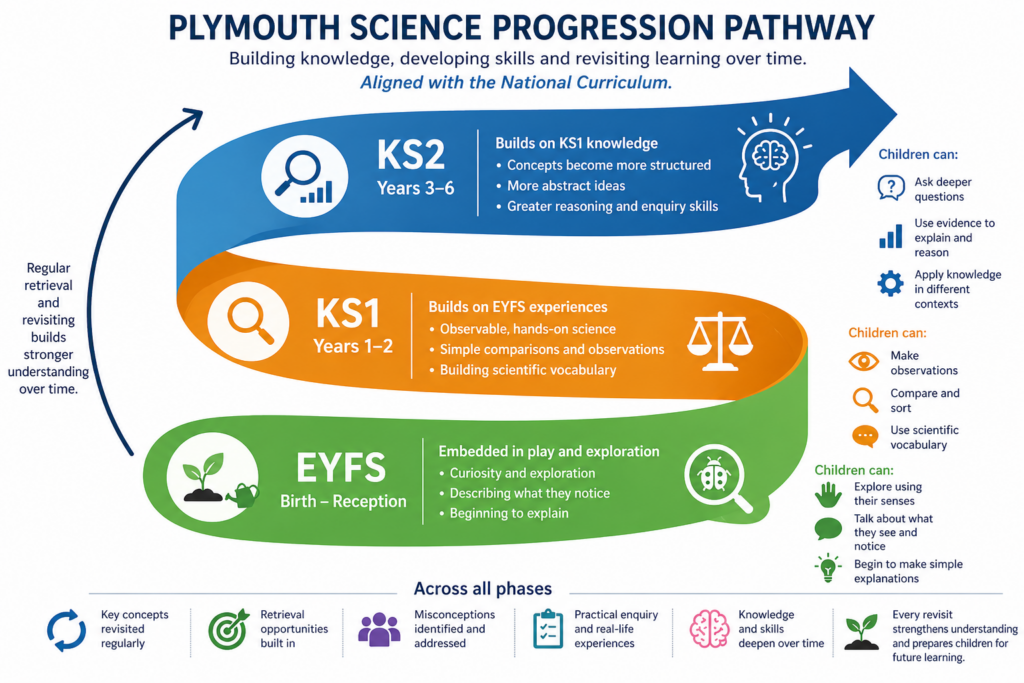
Our Science curriculum is supported by the Plymouth Science Scheme and this ensures that all children experience science in a fun, engaging, and practical way. We focus on:
- Knowledge Acquisition: Building a deep understanding of biological, physical, and chemical processes.
- Working Scientifically: Developing the skills of questioning, reasoning, and evidence-gathering through rigorous experimentation.
- Real-World Context: Using trips and expert visitors such as palaeontologists and museum visits to bring learning to life beyond the classroom.
We take a hands-on approach to learning, making the most of our extensive grounds, including wildlife gardens, ponds, and forest school areas and our goal is for children to leave our schools as confident scientists who can:
- Plan and conduct experiments with precision and reflect on their findings.
- Ask big questions and use scientific evidence to suggest answers.
- Collaborate effectively within a team, valuing the thoughts and ideas of their peers.
- Communicate complex ideas both verbally and in written form, using accurate scientific vocabulary.
The Core Pillars of Science
Pillar | Focus | What it looks like at Stoughton & Northmead |
Substantive Knowledge | Knowing the Facts | The specific scientific theories and concepts pupils learn (e.g., the parts of a plant, the states of matter, or the laws of forces). This is the ‘what’ of science, sequenced year-on-year to prevent gaps in understanding. |
Disciplinary Knowledge | Working Scientifically | The skills pupils need to be scientists. This includes: |
Vocabulary & Mastery | The Language of Science | Explicitly teaching Tier 3 scientific terminology (e.g., palaeontology, evaporation, photosynthesis). We ensure children can not only do the science but also explain the ‘why’ using precise language. |
Useful Links
National Geographic Kids – Articles and videos to spark curiosity
STEM Learning – Practical activities and investigations.
BBC Bitesize –Age-appropriate support and guidance for Science