
Pupil Premium
Pupil Premium Statement
The Pupil Premium is additional funding provided by the Government for state-funded schools in England, designed to raise the attainment of pupils who may be at a disadvantage, and to help close the gap between them and their peers. (GOV.UK)
Who is eligible
For the 2025–2026 academic year, the following children are eligible for Pupil Premium (PP) or related funding streams:
- Children recorded as eligible for free school meals (FSM), or who have been eligible for FSM at any point in the past six years (the “Ever 6 FSM” measure).
- Children previously looked after by a local authority or other state care who have since left care via adoption, a special guardianship order (SGO), or a child arrangements order (CAO) / residence order — referred to as “Previously Looked-After Children” (PLAC).
- Children currently looked after by a local authority (LAC). For looked-after children, the funding is managed by the child’s local authority virtual school.
- Children from service families (“service children”) — that is, children whose parent(s) serve in the regular armed forces (including full-time reservists stationed in England) or who receive an armed forces pension following a parent’s death in service. This is funded via the “Service Pupil Premium” (SPP).
If a child is eligible under more than one category, they are counted only once (never double counted).
Funding Rate
The per-pupil funding values for this academic year are as follows. (GOV.UK)
| Eligibility category | Primary (Reception – Year 6) |
| Ever 6 FSM / Ever 6 eligibility | £1,515 |
| Previously looked-after children (PLAC) | £2,630 |
| Looked-after children (LAC) | £2,630 |
| Service children (SPP) | £350 (additional) |
Schools receive PP grant for Ever 6 FSM and PLAC pupils. For LAC pupils, the funding is managed by the relevant local authority.
Use of the funding and accountability
- The Pupil Premium is not a personal entitlement or a ring-fenced budget for each individual child. Rather, it is funding for the school as a whole. As schools we have autonomy in deciding how best to use the funding to support eligible pupils.
- We may use the funding to provide targeted interventions (e.g. one-to-one tutoring, catch-up sessions), or to support wider strategies (e.g. whole-class teaching improvements, pastoral support, enrichment, social or emotional support) — including for pupils who do not meet the eligibility criteria but whose needs may align with the school’s overall strategy for raising attainment and reducing disadvantage.
- We are required to publish online how they have used their Pupil Premium allocation, and to report on the impact of that spending — to ensure transparency and accountability to parents, governors, and the broader community.
Our Commitment
- We commit to using Pupil Premium funding in a considered, evidence-based way to support our disadvantaged and vulnerable pupils.
- We will regularly monitor and evaluate the impact of spending, to ensure the provision is effective and appropriately addresses pupils’ academic, emotional, social or other barriers to success.
- We will publish a clear Pupil Premium Strategy Statement each year, outlining:
- How much funding we have received;
- How we intend to spend it;
- How we will assess its impact;
- How anyone can find details of the published review of impact.
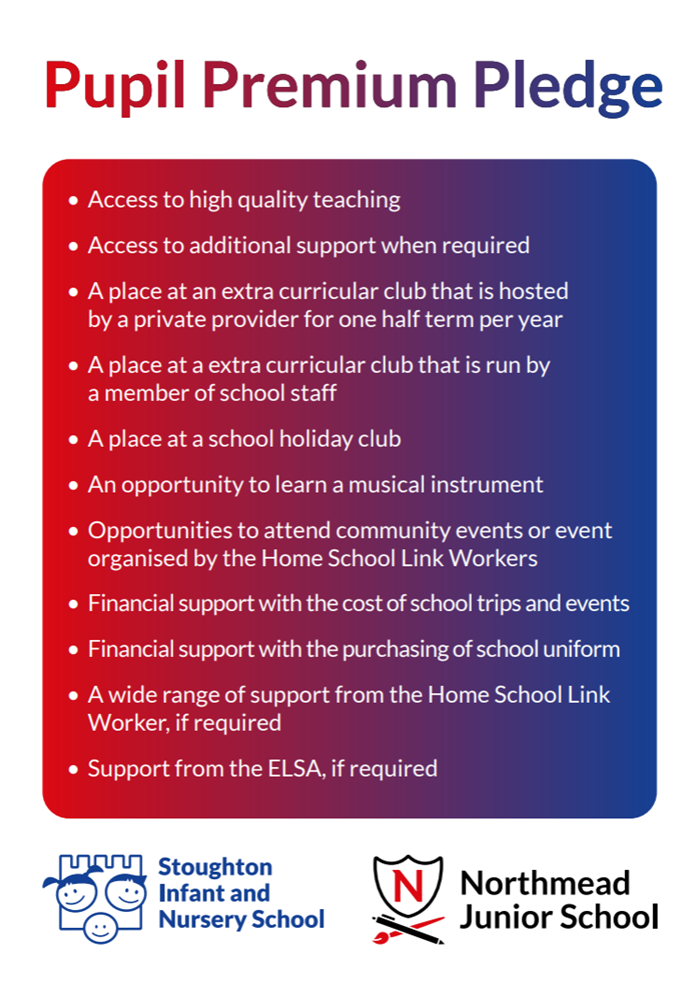
Our Pledge
Useful Links
Parentkind – Offers simple, practical resources across subjects plus wellbeing advice and parent webinars to help families support learning at home.
Little Owls Resources – Free printable games and learning activities designed by teachers to support early learning through play at home.
Pearson – Primary Learning Support for Parents – Free activities, tips and advice to help parents support learning and build confidence at home.
Home Start – Provides local volunteer support for families who may be struggling with isolation, mental health, or parenting challenges — practical, non-judgemental help at home.